When I was in class 11th, I fell in love with a book.
It was Concepts of Physics by H. C. Verma. If you grew up in India and studied science, you probably know it. For many of us, it was not just a textbook — it was the first book that made physics feel like something alive, something that could be understood rather than merely memorised.
I was living in a tiny village in Uttar Pradesh at the time. I had no tutor, no coaching centre, no older student I could call on. What I had was curiosity, a stack of books, and a habit of reading the same passage ten times until something clicked.
While reading H. C. Verma, I hit a wall. There were concepts I could not resolve no matter how many times I went back to the page. I looked through other books — I used to hoard books by multiple authors on every subject, hoping that one author’s explanation would unlock what another’s had obscured. Sometimes it worked. This time, it did not.
The Letter
I am not sure exactly when the idea came to me. But at some point I thought: why not write to H. C. Verma directly?
He was a professor at IIT Kanpur. I was a schoolboy in a village. I had no connection to him, no introduction, no reason to expect anything. But I had his doubts in my head and his address — printed right there in the book.
So I wrote a letter. I described my questions as clearly as I could. I folded the pages, addressed the envelope, and posted it.
I had no real expectation of a reply. I told myself I probably would not hear back. But I had asked the question, and there was something satisfying in that alone.
Then his reply arrived.
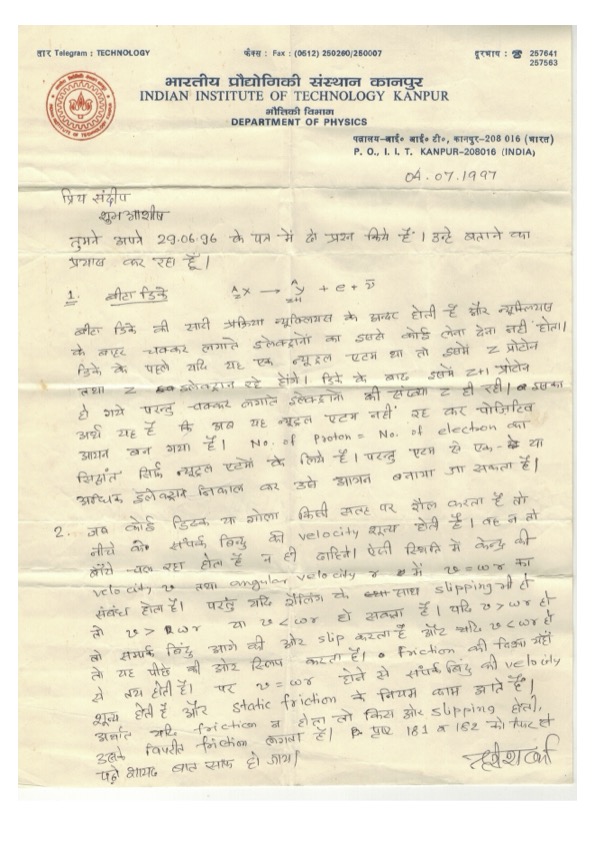
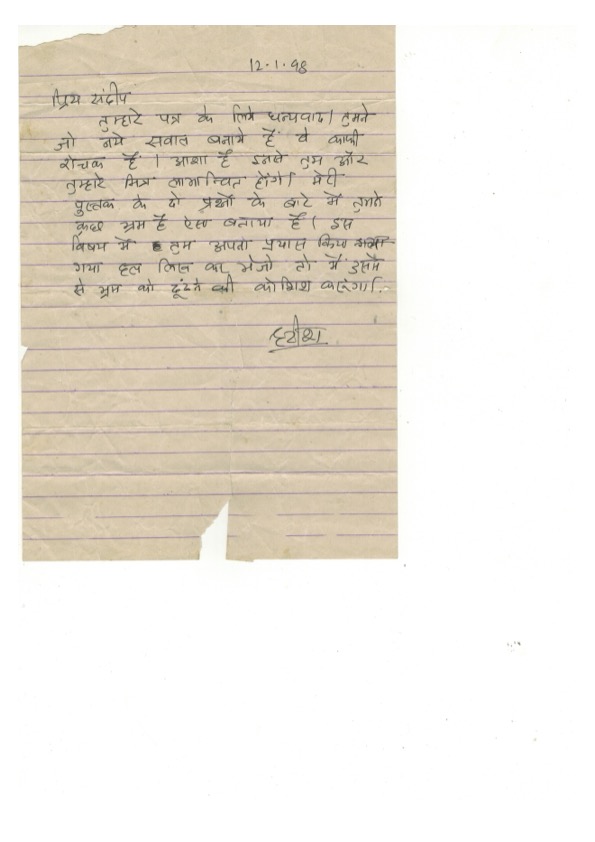
He had written back — in Hindi, in a warm and careful hand. He addressed my questions one by one. He did not write like a busy professor brushing off a student. He wrote like someone who genuinely cared that the ideas landed. The letter was patient and kind and precise.
I have thought about that moment many times since. A professor at one of India’s most demanding institutions, receiving a letter from an unknown schoolboy in a village he had never heard of, and choosing to sit down and write back. In Hindi. With care.
Something shifted in me that day. Not just because my doubts were cleared — though they were — but because of what the gesture meant. The world was not as closed as it had seemed from where I was standing. The distance between a student and a teacher was not fixed. It was crossable. By a letter.
Bjarne Stroustrup
A few years later, when I reached college, the same instinct resurfaced.
I had become absorbed in C++. I was reading everything I could find, writing programs, trying to understand the language at a deeper level. And I found myself with questions that books did not answer — questions about design decisions, about why the language worked the way it did.
Bjarne Stroustrup had invented C++. He was at Bell Labs and later at Texas A&M, one of the most influential computer scientists alive. I wrote to him.
He wrote back. Not once — several times. In detail. He engaged with the questions as if they were worth engaging with, because to him, perhaps, any sincere question about the language he had spent his life building was worth engaging with.
I want to be careful not to overstate this. These were not long friendships or mentorships in any formal sense. They were exchanges — brief, specific, generous. But they were enough to teach me something I have carried ever since.
What I Learned
The lesson is not about networking. It is not a productivity tip or a career hack.
It is something more fundamental: most people who have built something meaningful care deeply about the ideas behind it. Ask them a sincere question about those ideas, and there is a real chance they will answer.
The famous scientist, the author whose book you loved, the founder whose work changed how you think — they are not behind a wall. They are human beings with email addresses and, sometimes, a genuine pleasure in being asked something real by someone who clearly cares.
The worst that can happen when you reach out is silence. You were already in silence before you asked. The asking costs almost nothing. The answer, when it comes, can change everything.
I have been on the other side of this now. As someone who has taught many thousands of people, I receive messages from students and learners asking questions — sometimes deeply technical, sometimes personal, sometimes just a thought they wanted to share. I try to reply to as many as I can.
Because I remember what it felt like to post that letter from a village in UP, with no confidence it would reach anyone, and then to find that it had.
The Stars
There is a line I keep coming back to, one I used when I shared this story on LinkedIn:
The stars are closer than you think.
The people whose work has shaped you — the authors, the teachers, the builders — often feel remote. Their names are on book covers and conference programmes. They exist at a distance that seems unbridgeable from wherever you are standing.
But the distance is mostly in our heads. It is made of the assumption that we are not important enough to ask, that our questions are not interesting enough to warrant a reply, that the gap between where we are and where they are is too large to cross with something as simple as a letter.
It is usually not.
Ask the question. Write the letter. Send the email.
The answer might be silence. But it might be a reply in Hindi, written by hand, from a professor at IIT Kanpur, that changes the way you see the world.
If you have a similar story — of reaching out to someone whose work mattered to you, and being surprised by what happened — I would genuinely love to hear it.
If this essay resonated, tap to applaud